
Reading, PA · Garage Door Service
Replacing a 1980s Garage Door in Gilbertsville
Most Gilbertsville homes date to the early 1980s, when steel doors and openers were standard. We install replacements here, traveling 17 miles from Reading.
- Repairs & new doors
- Springs & openers
- Serving 8 nearby communities
What It Costs
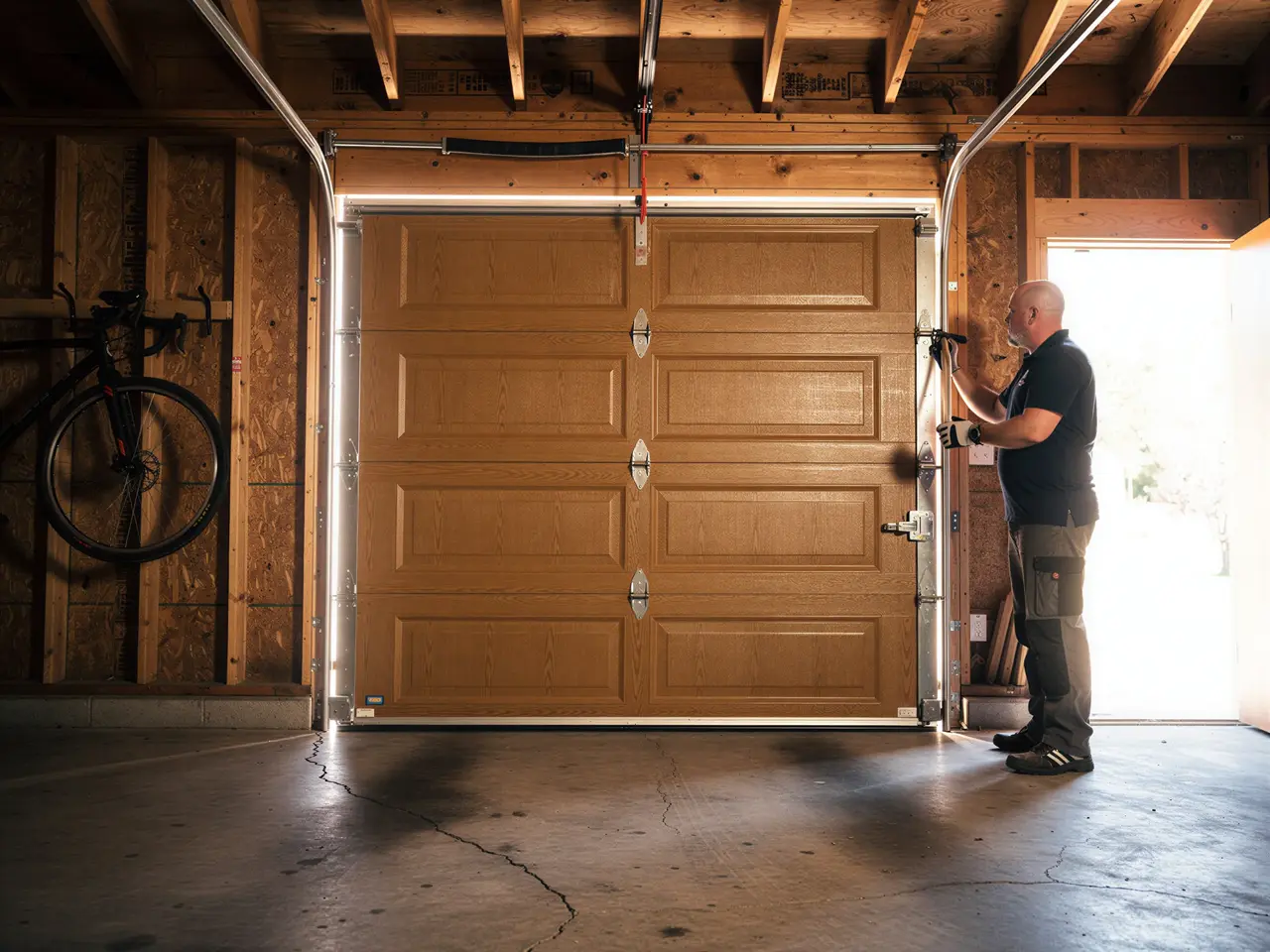
We don't quote a number here because the right door for a 1982-era opening isn't the same as the right door for a house built in 1958. Gilbertsville's housing mostly went up in the early 1980s, which means single-layer steel doors on standard torsion or extension hardware, sized for openings that were builder-standard at the time. With a median household income of $117,426 here, well above the $85,952 figure for the broader Reading service area, a lot of the calls we get from this part of town are upgrades, not patch jobs: insulated steel or composite doors instead of whatever hollow steel panel has been rattling in the track since the house was built. What drives the number on your invoice is the door itself, the opener if it's being replaced too, and whether the track and jambs need rework to take new hardware. We won't quote a figure sight unseen, and anyone who does for a door they haven't measured is guessing. What we can tell you up front is that a straight swap, same size opening, same door type, costs less than converting to insulated panels or widening an opening that was never sized for a modern double-car door.
The DIY Question
A new install is not a weekend project, and the spring system is the reason why. Torsion springs store enough force to break bones if the winding bars slip, and extension springs, more common on doors from this era, can launch a cable or a bracket across a garage if they let go under tension. That's true everywhere, but it matters more here because so many Gilbertsville doors are original to houses built around 1982 and the hardware has never been touched since. If you're set on doing some of the work yourself, hanging the new door panels once the opening is prepped is the part most homeowners can manage safely. Sizing the opening, setting the track plumb, and winding the spring to the right tension are the parts where a mistake either breaks the door again in six months or breaks you. We'll say plainly: we'd rather lose the labor on a job you could've done than get a call because a spring let go while someone was improvising with a socket wrench.
The Complications
The complication we run into most in this part of the service area isn't the door, it's the opening. Houses built around 1982 often have framing and header clearance sized for the door that came with the house, not for today's standard panel heights or for an insulated door's thicker section. Swapping in a new door sometimes means shimming the track, reworking the header, or trimming the opening rather than a straight bolt-in. Winters here are classified as severe cold, and a door from this era rarely has any real thermal break at the jamb, so an upgrade to an insulated door also means paying attention to weatherstripping and the bottom seal, not just the panel. One limitation worth naming: if the framing around the opening has shifted or rotted, that's carpentry work outside a straight door install, and we'll tell you before we start rather than force a door into an opening that isn't square. Forcing it just means a door that binds, an opener that strains, and a callback in a year.
How It Shows Up
On a house from this era, failure usually starts quiet. The door gets slower to close, or it reverses partway up for no clear reason, and that's often the opener straining against a spring that's lost tension rather than the opener itself failing. Panels from original 1980s steel doors dent and bow more easily than anything made today because the steel gauge was thinner and there's no insulation layer backing it. You'll also see daylight at the bottom seal once the original weatherstripping hardens and cracks, which in a severe-cold climate means real heat loss into an attached garage. None of that means the door is done, but when the track is bent, the panels are bowed in more than one section, and the opener is already compensating, replacement usually makes more sense than another round of repairs on hardware pushing forty years old.
Time on the Job
A straight swap, same opening, same door type, is a same-day job once the door and opener are on the truck. Where the timeline stretches is the prep: if the opening needs reframing, if the track mounts have to be relocated, or if the header isn't sized for an insulated door's thickness, that adds time before the new door ever goes up. Because the crew is coming from Reading, roughly 17 miles out, a job that needs a second trip for parts or a framing fix means scheduling around that distance rather than a same-afternoon return visit. We'd rather tell you upfront that a job might run two visits than promise one and miss it.
Why This Fails Locally
The pattern here comes down to three numbers. Most houses in Gilbertsville were built around 1982, which puts the original doors and openers near or past the end of their working life regardless of how well they've been maintained. The area sits in a severe cold climate zone, so a door without a real thermal break has been losing heat into the garage for decades without anyone noticing it as a garage door problem instead of a heating bill problem. And at 2,157 households, this is a smaller, higher-income pocket of the wider Reading service area, with a median income of $117,426 against $85,952 for the broader area, which is part of why upgrade jobs here lean toward insulated doors rather than like-for-like replacements. None of that is true of every town in the service area. It's true of this one because of when it was built and what the winters do to a door that wasn't made to handle them.
Frequently asked questions
Why do so many doors in Gilbertsville need replacing around the same age?
Most of the housing here was built around 1982, so a lot of original steel doors and openers are now pushing forty years old at the same time. Springs, tracks, and door panels all have a working life, and when a whole neighborhood went up within a few years of each other, the failures tend to cluster the same way.
Does the company have a branch in Gilbertsville?
No. Jobs here are run from Reading, about 17 miles out. That doesn't change how the install is done, but it does mean scheduling accounts for the drive rather than a walk-in shop around the corner.
Is it worth upgrading to an insulated door here?
Given the severe cold winters and how little thermal break most original 1980s-era doors have, a lot of homeowners in this area choose insulated steel or composite when replacing. It's not required, but if the garage is attached or used as workspace, the difference is noticeable.
Can the existing opening fit a new standard door?
Usually, but not always. Openings framed around 1982 were sized for the door that came with the house, so a thicker insulated panel or a different standard height sometimes needs header or track adjustments before the new door goes in.
More garage door services in Gilbertsville
Book garage door service in Reading
Call now or request a quote - tell us what the door is doing and where you are.