Reading, PA · Garage Door Service
Garage Door Cable Repair for Reading-Area Homes
Snapped or frayed garage door cables are common on Reading's 1960s-70s housing stock. Here's why it happens and what a proper cable repair involves.
- Repairs & new doors
- Springs & openers
- Serving 8 nearby communities
Why This Fails Locally
Most of the housing around Reading went up between 1938 and 2003, with the bulk of it dating from the 1960s and 70s across the 58 named communities in this service area. Doors on those houses have had decades to put wear on their lift cables, and a lot of that original cable has never been swapped out. Add a cold-severe climate to the mix and you get cables that take a beating every winter: the steel strands contract in the cold, road salt and slush get flung up into the tracks, and the drums the cables wind around start to rust at the edges where moisture sits. A cable that's fine in August can fray or snap outright on a 10-degree morning because the metal has less give left in it. This isn't a design flaw in any one door - it's just what happens to original 1960s-70s hardware after fifty-plus winters of that kind of temperature swing. Owners in older sections of the region tend to see this fault show up in clusters during the first hard cold stretch of the season, because that's when a cable that's been slowly wearing finally gives out.
What the Fix Involves
A cable repair starts with releasing tension safely - that means clamping or locking the door before anything gets touched, since a loaded spring and a snapped cable together is not something to work on blind. From there it's pulling the old cable off the drum, checking the drum itself for rust or a chewed-up groove (common on the older stock in this area), and running a new cable sized to match the door's weight and track length. Both cables usually get replaced together even if only one broke, because the other side is carrying the same age and the same wear. We also check the bottom brackets and the pulley if the door has one, since a cable that frayed against a bad pulley will just fray the replacement too if that part doesn't get fixed at the same time. On double doors, which carry more weight across a wider span, we pay close attention to how evenly the cable is seating on the drum before calling the job done - an uneven wrap is how a brand-new cable fails in six months instead of lasting years.
The DIY Question
A frayed or snapped cable is not a safe DIY repair, and we'll say that plainly: the door is either under full spring tension or has just lost that tension unevenly, and either state can snap a bar or drop a panel on someone who doesn't have the clamps and winding bars to control it. We're honest that some garage door problems are simple enough for a homeowner to handle - a sticky roller, a misaligned sensor - but a lift cable isn't one of them. If you've got the tools and have done this kind of mechanical work before, fine, but most people haven't, and the margin for error with a loaded torsion spring is thin. One honest limitation on our end: if a drum or shaft is badly rusted from years of winter exposure, a cable swap alone won't hold, and we'll tell you that up front rather than sell you a repair that's going to fail again by spring.
How It Shows Up
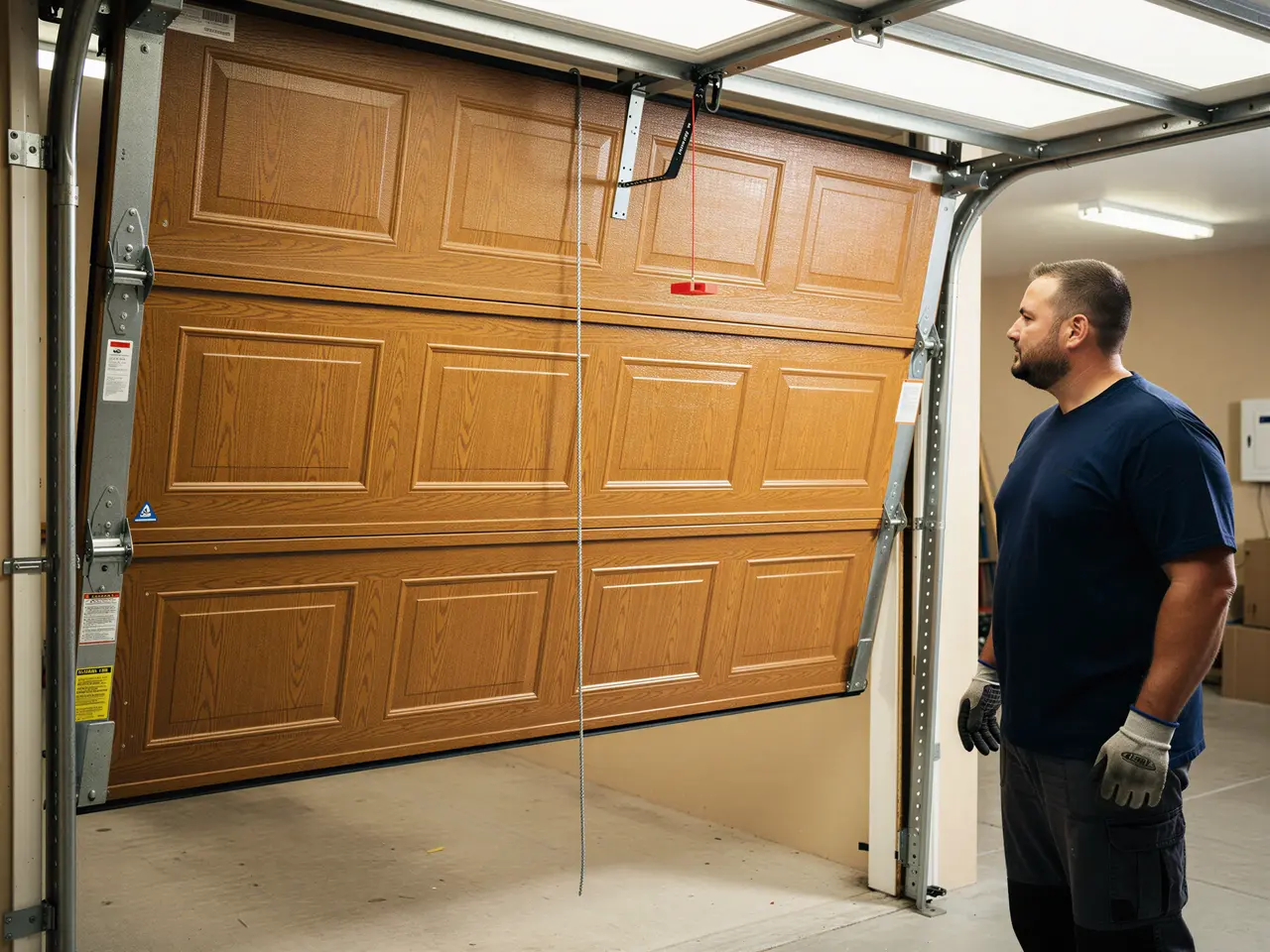
The most common sign is the door hanging crooked - one side higher than the other, because one cable has stretched, slipped off the drum, or broken while the other is still holding. You might also hear a loud bang or snap, usually when the door is opening or closing and the tension lets go all at once. Sometimes it's quieter: a slow fraying cable will make a faint scraping or popping sound against the track for days or weeks before it finally gives. If the door won't move at all and looks like it's resting unevenly on the floor, that's usually both cables gone or one cable plus a jammed track. Given the age of a lot of the housing stock in this area - homes built well before modern opener safety features were standard - a cable failure can also trip an opener's force sensor repeatedly, which homeowners sometimes mistake for an opener problem when the cable is the actual cause.
Frequently asked questions
Why do garage door cables fail more in winter around Reading?
Cold-severe conditions mean the steel in the cable contracts and loses flexibility, and road salt and moisture speed up rust on the drum and bottom brackets. Combined with how much of the area's housing dates to the 1960s and 70s, a lot of original cable is simply past its working life by the time a hard freeze finally breaks it.
Can I replace just one cable if only one broke?
You can, but we usually recommend replacing both since they're carrying the same age and wear. A single new cable paired with an old one close to failure just means a second repair call within a year or two.
Is a broken cable the same as a broken spring?
No. A spring provides the lifting force; a cable guides the door along the track as it winds on the drum. They fail for different reasons and get fixed differently, though a bad cable can sometimes cause enough strain to damage a spring too.
How old does a garage door need to be before cable wear is a real concern?
There's no fixed age, but doors on housing from the 1960s and 70s - common across this area - are well past the point where original cable should still be trusted. If the cable looks frayed, rusted, or kinked anywhere, it's worth replacing before it snaps.
By Neighborhood
Cable Repair across the Reading area
We also handle cable repair in these Reading-area suburbs.
Book garage door service in Reading
Call now or request a quote - tell us what the door is doing and where you are.