
Reading, PA · Garage Door Service
Wind and Wide Doors: What Reading Homeowners Need to Know
Reading's older double-door garages and cold-band wind loads work against each other. Here's what to check on 1960s-70s housing stock before a gust takes the panel.
- Repairs & new doors
- Springs & openers
- Serving 8 nearby communities
What to Look At First
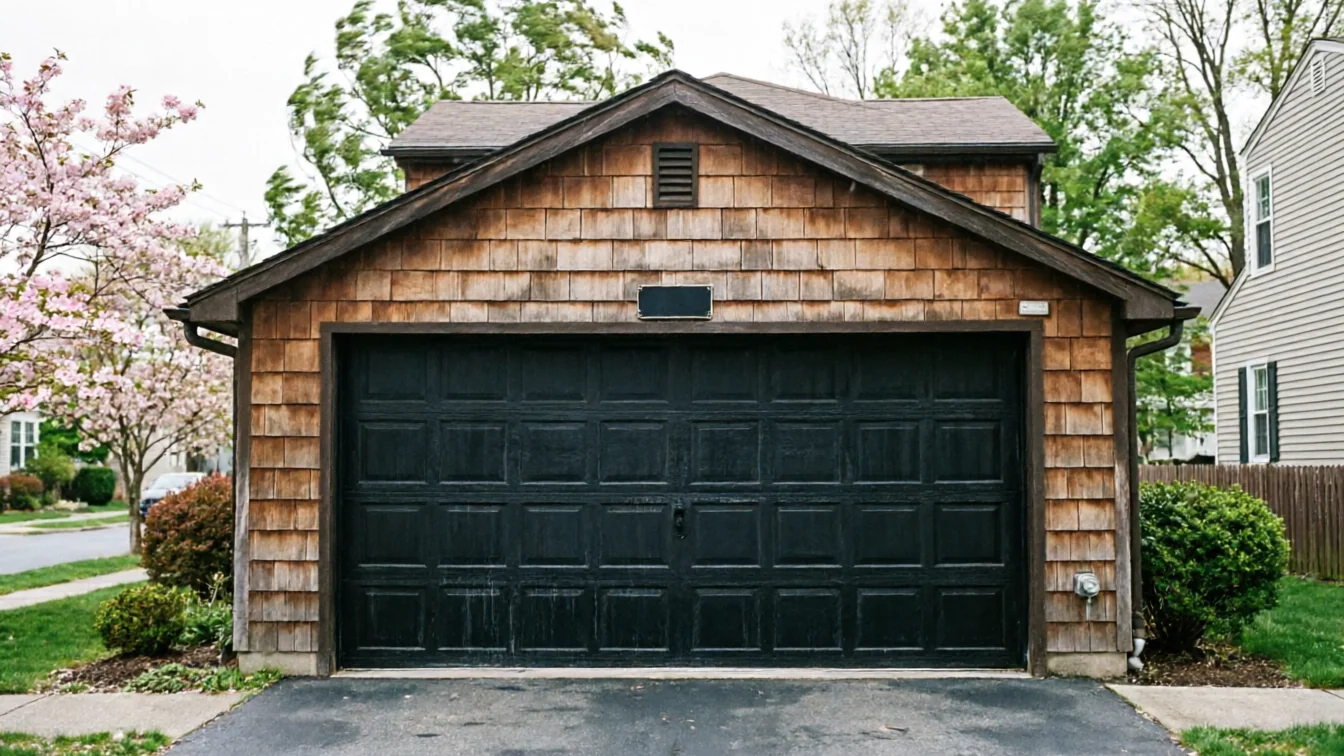
Start with the track brackets, not the panels. Most of Reading's housing went up between 1938 and 2003, with the bulk of the stock dating to the 1960s and '70s across the area's 58 named neighborhoods - and that generation of double-wide garage doors was built to a lighter wind standard than anything going in today. Look at where the vertical track bolts into the jamb. On a door that age, you're often looking at the original lag bolts, sometimes into framing that's shifted a little over fifty-plus years. If you can wiggle the bracket by hand, a gust doesn't need much more than that.
Next check the struts - the horizontal bars across the back of the top one or two panels. A single-car door can often get by without reinforcement. A double-wide door, the kind common on the ranch and split-level houses built through this era, needs it, because the panel has twice the surface area pushing and pulling on the same hardware. If your struts are missing, or there's only one where the door calls for two, that's a gap worth closing before it becomes a torn panel.
This isn't a cosmetic issue. It's a structural one tied directly to how this town's garages were built, decades before current wind-load thinking caught up to double-door spans.
The Situation
Reading sits in a cold-severe climate band, which matters here less for the cold itself and more for what comes with it - fast-moving fronts, the kind that build pressure differences across a flat door face in a hurry. A single-car door shrugs most of that off. A double-wide door, 16 feet across, catches a lot more wind than its narrower neighbor, and on a house built in the 1960s or '70s, the hardware holding it in the track usually wasn't sized with that span in mind.
The failure point is rarely the panel skin itself. It's the track pulling away from the jamb, or a center support buckling under a gust that hits the door broadside while it's closed and sealed tight. A closed door with no air escaping anywhere is a sail with nowhere to flex.
Across the service area - 89,740 households, with 36,624 of those owner-occupied houses - a meaningful share are the original builder-grade double garages from that construction era, never upgraded. That's not a guess about any one house; it's the general pattern this town's housing stock falls into, and it's the reason a gust that would barely register on a newer, reinforced door can do real damage here.
When to Get Help
Call before the next windstorm, not after, if any of these apply: the door rattles or flexes visibly when wind hits it, the track brackets show daylight between the bolt and the jamb, or you've got a double-wide door with no strut reinforcement across the top panels. None of those are urgent emergencies on a calm day, but they're exactly the things that turn into an emergency call once the wind picks up.
If the door has already been hit - a bowed panel, a bent track, a section pulled loose - don't try to force it closed or run the opener through it. A bent track under load can bind the rollers hard enough to strip the opener's drive gear, turning a $200 repair into a full opener replacement.
One honest limit here: if a panel is torn or badly creased, reinforcing it after the fact doesn't fix the underlying problem - the panel is compromised and a strut won't make a torn skin strong again. At that point you're looking at panel replacement, not a brace-up. We'll tell you straight when a repair isn't worth doing instead of installing new struts on a door that needs more than that.
What Local Conditions Do
The combination here is specific: older double-wide doors, original hardware, and a cold-severe climate band that brings sharp pressure swings along with the winter weather. None of those three facts alone is unusual. Together, on a house built in the stretch between 1938 and 2003 - median right around 1970 - they add up to doors that were engineered for a calmer wind picture than what actually shows up.
This plays out differently house to house depending on orientation and exposure, which is part of why a blanket answer doesn't work. A door facing an open yard takes a different load than one tucked behind a neighboring structure. What doesn't change by address is the construction era: if your garage dates to that mid-century build-out, the hardware wasn't speced for today's double-door wind-load tables, full stop.
The fix isn't usually a new door. It's track reinforcement, correctly sized struts, and bracket hardware rated for the span you've actually got, not the span the builder assumed in 1968. Get that right once and the door stops being the weak point in the wall.
Frequently asked questions
Why does my double garage door shake more in wind than my neighbor's single door?
Surface area. A double-wide door, common on Reading's 1960s and '70s houses, catches roughly twice the wind load of a single-car door on the same wall. If the original struts and track hardware were never upgraded, that extra load has nowhere to go but into brackets that were sized for a lighter era of garage door construction.
Can I just add struts myself to stop the flexing?
You can buy strut kits, but sizing them wrong does little good - the strut has to match the door's panel height and span, and it has to be bolted into framing that can actually take the load. If the jamb or track bracket is already loose, a strut alone won't solve it. That's a hardware inspection job, not a weekend add-on.
Is it the cold or the wind that's the real problem here?
Both, but differently. The cold-severe band Reading sits in brings the fast-pressure-change weather that stresses an already-undersized door. The cold itself mostly affects spring tension and lubrication. The structural risk to a wide door comes from wind load against original-era hardware, not from low temperatures on their own.
Related garage door services in Reading
More garage door guides
Book garage door service in Reading
Call now or request a quote - tell us what the door is doing and where you are.